Platform
The intelligent enterprise decision layer
Plain English in, certified optimal out, with audit gates at every stage and a context graph that compounds on every run.
Platform overview
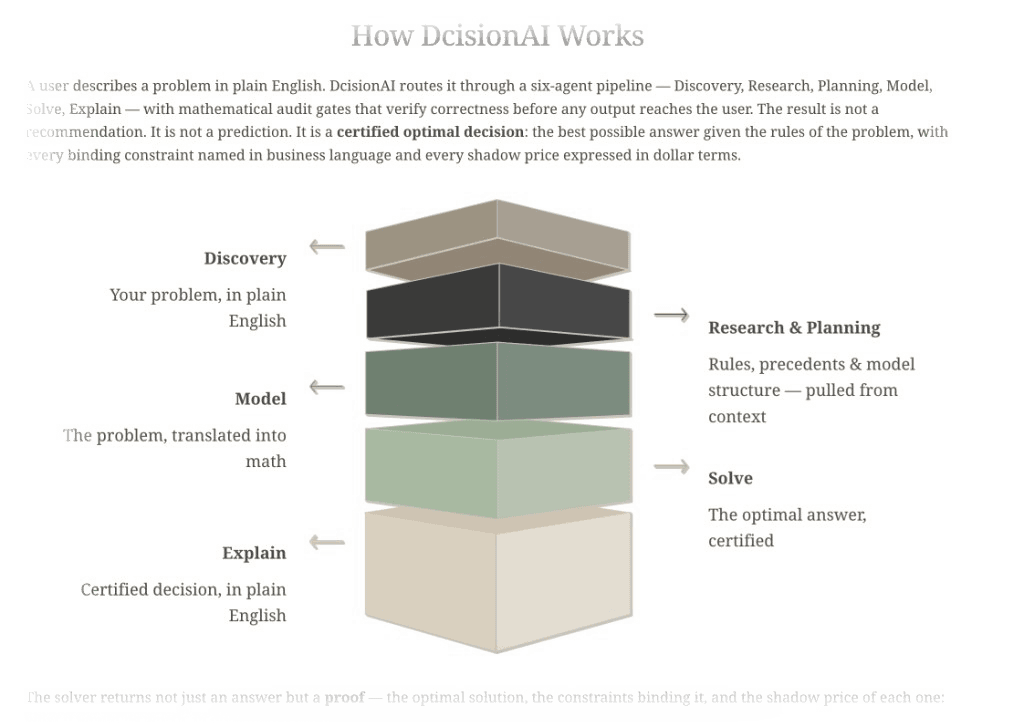
How DcisionAI Works
Where It Lives
DcisionAI meets you wherever you already work, inside Amazon Q or Claude for business users, on the web for teams that want direct access, and in the IDE for developers. No rip-and-replace. No integration project.
Amazon Q
Enterprise teams in AWSDecision intelligence inside the workspace your operators already use.
Claude
Business & knowledge workersPlain-English problems, certified outputs, no standalone app required.
Web platform
Teams that want direct accessGuided UI for analysts and decision owners who need a dedicated surface.
IDE & MCP
Developers & integratorsCursor, Claude Desktop, and APIs, embed the decision layer in your stack.
When constraints collide
When the Math Finds What Humans Miss
Infeasibility is not a failure, it is often the most valuable diagnostic DcisionAI produces.
Problem submitted
A manager describes the problem in plain English: allocate $240M across 38 positions subject to ESG mandates, sector concentration limits, and a minimum yield requirement.
DcisionAI finds infeasibility
No solution satisfies all constraints at once. The solver returns an IIS: the ESG mandate and minimum yield requirement are in direct mathematical conflict.
Shadow price surfaces the tradeoff
Relaxing the minimum yield by 30 basis points resolves the conflict. The shadow price quantifies it: that relaxation is worth $2.1M in portfolio value.
Human reviews and overrides
The manager relaxes the yield floor only on two positions, not the full portfolio, with documented rationale tied to updated client risk tolerance.
Override captured, context graph updated
Who overrode, what changed, why, and which constraints held firm become institutional knowledge, encoded, auditable, and available on the next run.
The DcisionAI Learning Flywheel
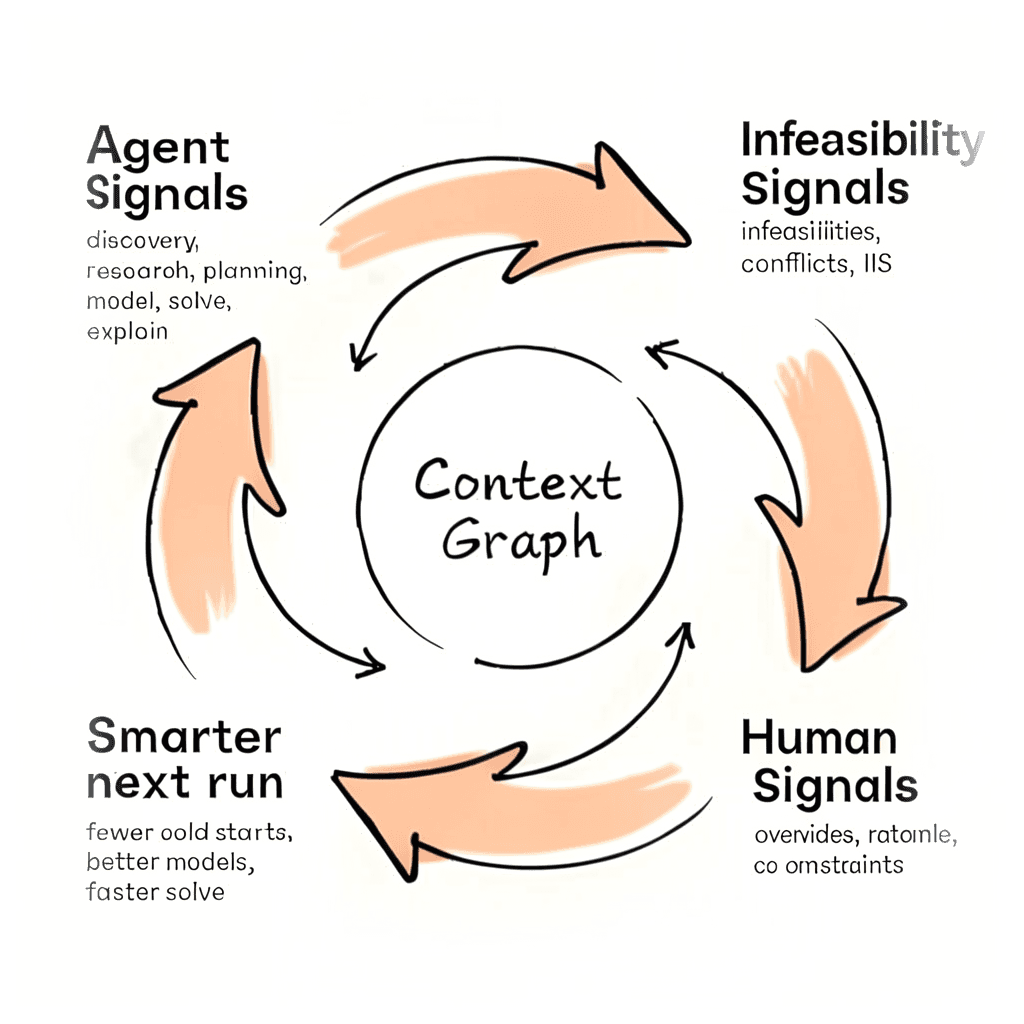
Every run, override, and outcome feeds one asset: the context graph. Three signal types tighten the loop so each cycle is cheaper and more accurate than the last.
Agent signals
Optimal solutions, binding constraints, and shadow prices, recorded on every run.
Infeasibility signals
Where constraints collide: irreducible sets, conflicts, and the dollar value of relaxing a rule.
Human signals
Who overrode the math, what changed, and why, auditable institutional memory for the next run.
Built for the governance era
Compliance Is the Floor. The Context Graph Is the Asset.
As the model layer commoditizes, governance becomes the differentiator. Enterprises now have hundreds of agents running across the organization, most with no audit trail, no lifecycle management, and no visibility into what decisions they're making or why.
DcisionAI's architecture solves this structurally. Every decision produces a complete, machine-readable audit trail: who asked, what constraints bound the solution, which rules were binding, which were overridden, by whom, and with what documented rationale.
When the EU AI Act requires explainable, auditable high-risk AI decisions, DcisionAI's output is conformant by construction, not reconstructed after the fact.
Platform Capabilities
Core innovations that make DcisionAI the decision infrastructure layer for the enterprise
Coordination Layer
The orchestration layer that sits above systems of record, adjudicates context, enforces constraints mathematically, and ensures reliability across autonomous workflows.
Context Graph: Decision Memory
Decision traces capture the 'why', not just what happened, but why it was allowed. The living graph that connects decisions across systems and time.
Proof Engine: Mathematical Certificates
Provides mathematical certificates of optimality, not just confidence scores
Data Flywheel: Self-Improving
Every decision generates a decision trace that enriches our context graph, the system gets better with usage. Precedent becomes searchable.
Domain-Agnostic Optimization
Works across any industry without domain-specific setup, from portfolio allocation to hospital scheduling